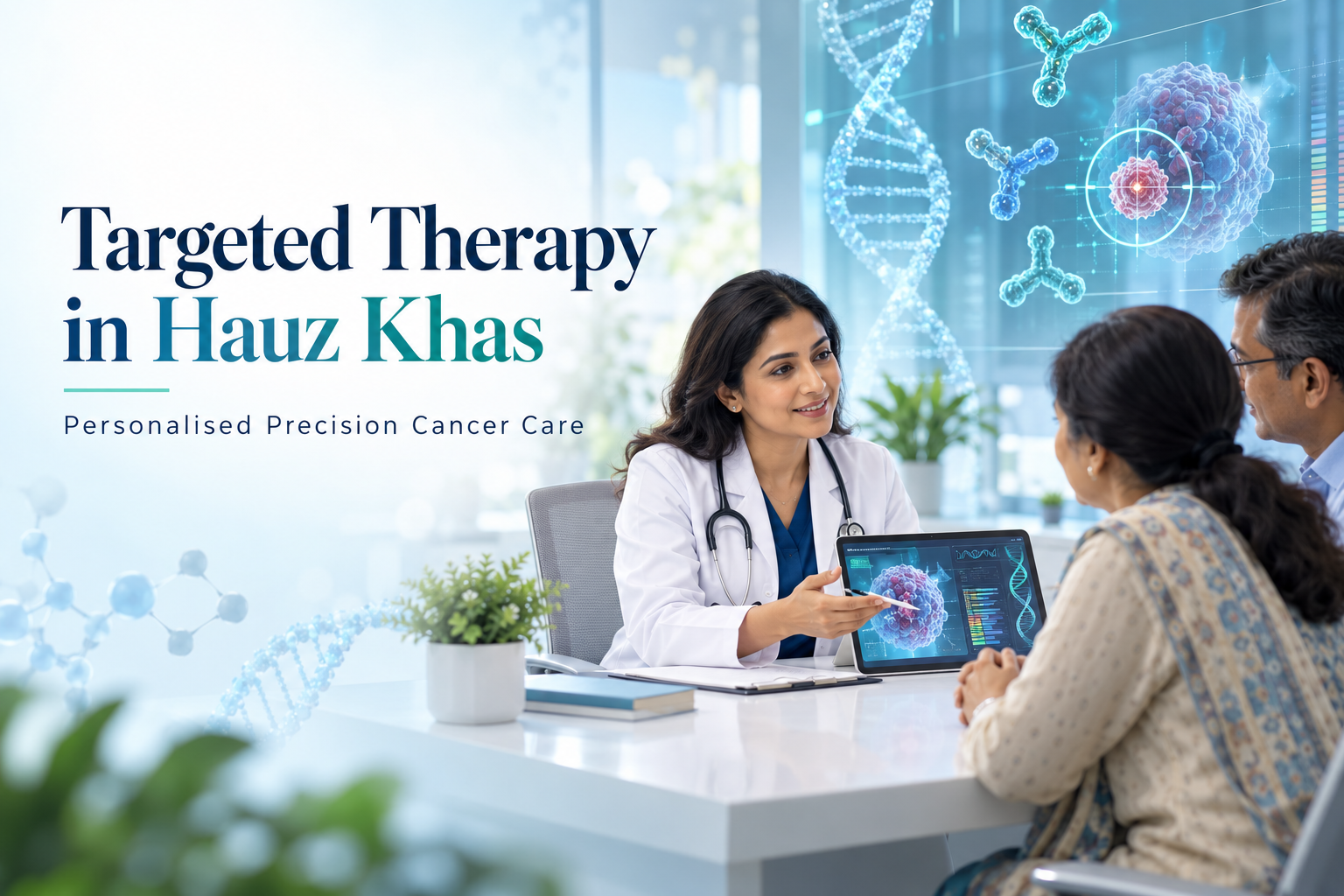
Cancer treatment is becoming more personalised with the help of modern diagnostics, biomarker testing, and molecular research. Instead of using the same treatment approach for every patient, doctors can now study specific changes inside a tumour and use that information to guide therapy. This is where targeted therapy in Hauz Khas can play an important role for selected cancer patients.
Targeted therapy focuses on specific genes, proteins, or biological pathways that help cancer cells grow, divide, and survive. Unlike conventional chemotherapy, which generally affects rapidly dividing cells, targeted medicines are designed to interfere with particular features of cancer cells.
This approach is closely connected with precision medicine.
However, targeted therapy is not suitable for every cancer or every patient. Its usefulness depends on the cancer type, stage, molecular profile, previous treatments, and overall health. Patients considering targeted cancer therapy Hauz Khas may therefore require detailed oncology evaluation and biomarker testing before treatment is recommended.
At Shichim, the care pathway includes consultation, personalised treatment planning, day-care treatment where clinically appropriate, and ongoing monitoring throughout recovery.
What Is Targeted Therapy in Hauz Khas?
Targeted therapy in Hauz Khas refers to cancer treatment that acts on specific molecular features involved in cancer growth and survival.
Cancer cells often contain genetic or protein-level changes that differ from healthy cells. These changes may affect how cells receive signals, grow, divide, or communicate with surrounding tissues.
Some targeted medicines are designed to block these abnormal signals.
Others can interfere with blood-vessel formation, attach to proteins on cancer cells, or disrupt processes that cancer cells need to survive.
The goal is to make treatment more precise.
Instead of selecting therapy only according to where the cancer started, doctors may also consider the biological characteristics of the tumour.
This is the foundation of precision cancer treatment Hauz Khas.
Why Targeted Therapy Matters in Modern Cancer Care
Modern oncology increasingly focuses on understanding the individual biology of cancer.
Two patients may both have the same general cancer diagnosis, but their tumours can behave differently.
For example, one tumour may contain a particular mutation or protein that can be targeted with a specific medicine, while another tumour may not.
This is why biomarker testing has become so important.
Biomarkers can provide information about genes, proteins, or other biological characteristics of a tumour.
If a relevant target is identified, the oncologist may consider a treatment designed to act against that specific abnormality.
This can make molecular targeted therapy Hauz Khas more personalised than a one-size-fits-all approach.
How Does Targeted Therapy Work?
Cancer develops because abnormal cells gain changes that allow them to grow and survive when they should not.
These changes can activate pathways that continuously send growth signals.
Certain targeted medicines block these signals.
Some treatments work inside cancer cells, while others act on proteins located on the cell surface.
Other targeted therapies may interfere with the formation of blood vessels that supply tumours with oxygen and nutrients.
In selected cancers, this can help slow tumour growth.
Targeted therapy can therefore work in several different ways depending on the biological target.
Main Types of Targeted Cancer Therapy Hauz Khas
Targeted treatments generally include small-molecule medicines and monoclonal antibodies, although several other specialised approaches also exist.
Small-Molecule Targeted Medicines
Small-molecule drugs are designed to enter cells and interfere with proteins or enzymes that support cancer growth.
Many of these medicines target abnormal signalling pathways inside cancer cells.
Some small-molecule treatments can be taken orally, although the method and schedule depend on the specific medicine.
For patients considering targeted therapy in Hauz Khas, the oncologist decides whether this type of treatment is suitable according to the molecular profile of the tumour.
Monoclonal Antibodies
Monoclonal antibodies are specially developed proteins that recognise particular targets.
Some attach to proteins on cancer cells and block signals that help them grow.
Others may help the immune system identify cancer cells or deliver treatment more directly to selected cells.
These medicines are usually given through specialised treatment protocols.
Anti-Angiogenesis Therapy
Tumours need blood vessels to continue growing.
Some targeted medicines interfere with angiogenesis, the process through which new blood vessels form.
Reducing these signals may limit the tumour's ability to maintain its blood supply.
This approach is used in selected cancer types.
The Role of Biomarker Testing
Biomarker testing is one of the most important steps before starting targeted cancer therapy Hauz Khas.
Testing may be performed using tissue obtained during biopsy or surgery.
In some cases, doctors may also consider blood-based molecular testing.
The goal is to identify genetic or protein changes that may influence treatment selection.
For example, if a tumour contains a specific mutation that has an established targeted medicine, the oncologist may consider that treatment.
However, finding a mutation does not always mean that a matching therapy is available or appropriate.
Some molecular changes have clear treatment relevance, while others may still be under research.
This is why molecular reports should be interpreted by an oncology specialist.
Who May Be Suitable for Targeted Therapy?
Not every patient is suitable for targeted therapy.
An oncologist may consider several factors before making a decision.
These include the cancer type, stage, pathology, biomarker results, previous treatment, overall health, organ function, and the availability of an evidence-based targeted medicine.
Patients with the same cancer can therefore receive different treatments.
One patient may have a molecular target that can be treated with a specific medicine, while another may require chemotherapy, immunotherapy, radiation, surgery, or a combination approach.
That is the main principle behind precision cancer treatment Hauz Khas.
Tests Before Starting Targeted Therapy
Before treatment begins, doctors may review several investigations.
Blood tests can help assess liver function, kidney function, blood counts, and other health indicators.
Imaging such as CT scans, MRI, or PET scans may help evaluate the extent of the disease.
Molecular tests may also be required to identify relevant genetic or protein changes.
These investigations help the oncology team understand whether targeted therapy is suitable and provide a baseline for monitoring during treatment.
Shichim Care Journey for Targeted Therapy in Hauz Khas
Shichim follows a structured care pathway designed to make the cancer treatment process easier to understand.
Step 1: Call or Book
The journey begins when the patient requests an appointment or submits an enquiry.
A coordinator helps organise the next steps and guides the patient through the consultation process.
Step 2: Consultation
A senior oncologist reviews the diagnosis, medical reports, previous treatment, and current health condition.
This stage is especially important for targeted therapy in Hauz Khas, because treatment depends on the individual biology of the cancer.
Relevant biomarker or molecular information may also be reviewed.
Step 3: Personalised Treatment Plan
If targeted therapy is clinically suitable, a personalised plan is created.
The treatment may be used alone or combined with chemotherapy, immunotherapy, radiation therapy, hormone therapy, or other approaches depending on the cancer.
The treatment schedule depends on the medicine and clinical situation.
Step 4: Day-Care Treatment
Some targeted therapies can be administered in a day-care setting.
When clinically appropriate, patients may receive treatment under medical supervision and return home the same day.
Other targeted therapies may be taken orally and monitored through scheduled oncology appointments.
Step 5: Recovery and Monitoring
Ongoing monitoring is a key part of targeted therapy.
Doctors may review symptoms, blood tests, imaging results, and treatment response throughout the care journey.
Nutritional guidance and symptom management may also form part of recovery support.
Targeted Therapy vs Other Cancer Treatments
Targeted therapy is one of several treatment options available in cancer care.
| Treatment | How It Works | Selection Basis | Personalisation | Monitoring |
|---|---|---|---|---|
| Targeted Therapy | Acts on specific molecular targets | Biomarkers, cancer type, stage | Often highly personalised | Blood tests, scans, side effects |
| Chemotherapy | Affects rapidly dividing cells | Cancer type, stage, treatment goal | Less dependent on molecular targets | Blood counts and organ function |
| Immunotherapy | Helps the immune system respond to cancer | Cancer type, stage, immune biomarkers | Can be biomarker-guided | Immune-related effects and scans |
| Radiation Therapy | Uses high-energy radiation in a specific area | Tumour location and treatment objective | Individually planned | Local side effects and response |
There is no single treatment that is best for every patient.
The right approach depends on the individual diagnosis.
Potential Benefits of Targeted Therapy
One important advantage of targeted therapy is precision.
The treatment is designed around specific biological features of the cancer.
This can help doctors choose therapies with a clearer biological rationale.
Another advantage is treatment flexibility.
Some targeted medicines can be combined with other cancer treatments.
Certain medicines can also be taken orally, although this depends entirely on the drug.
However, targeted therapy should not be viewed as guaranteed to work.
Response varies between patients, and some cancers can eventually develop resistance.
Possible Side Effects of Targeted Therapy
Targeted therapy can still cause side effects.
The word "targeted" does not mean that healthy cells are completely unaffected.
Side effects vary depending on the specific medicine.
They may include fatigue, skin changes, diarrhoea, changes in blood pressure, liver-function changes, mouth problems, or blood-count abnormalities.
Some targeted medicines also require specific monitoring.
Patients receiving care at a targeted therapy centre Hauz Khas should clearly understand which symptoms need to be reported.
Early communication with the oncology team can help manage side effects more effectively.
Treatment Resistance and Other Challenges
Cancer cells can change over time.
A targeted therapy may initially work well but later become less effective.
This is known as treatment resistance.
Resistance can develop when cancer cells acquire new mutations or activate alternative growth pathways.
If this happens, doctors may consider further testing, a different targeted medicine, or another treatment strategy.
This is why molecular targeted therapy Hauz Khas requires regular monitoring rather than a one-time treatment decision.
Best Practices During Targeted Therapy
Patients can make their treatment journey safer and more organised by following medical instructions carefully.
Take prescribed medicines exactly as directed.
Do not change the dose or stop treatment without discussing it with the treating oncologist.
Attend scheduled blood tests, scans, and follow-up appointments.
Keep the medical team informed about all medicines and supplements being used.
Patients should also report new or worsening symptoms early.
Another important practice is to avoid comparing treatment plans with other cancer patients.
Even the same type of cancer can have different molecular characteristics.
Common Mistakes Patients Should Avoid
One common mistake is assuming that targeted therapy is suitable for every cancer.
A relevant molecular target usually needs to be identified first.
Another mistake is assuming that every mutation found in testing can be treated.
Some mutations may not have an established targeted medicine.
Patients should also avoid believing that targeted therapy has no side effects.
Regular monitoring remains important.
Finally, molecular characteristics can sometimes change as cancer evolves.
In selected situations, additional testing may be considered during the treatment journey.
Current Trends in Precision Cancer Treatment
Targeted therapy continues to advance as researchers learn more about cancer genetics.
New molecular targets are being discovered, and newer medicines are being developed to act against them.
Broader genomic profiling is also becoming more important in selected patients.
Instead of analysing only one gene, some tests can examine multiple genes at the same time.
Liquid biopsy is another developing area.
It may allow doctors to study cancer-related material in blood in selected situations.
Researchers are also exploring combinations of targeted therapy with immunotherapy and other treatments.
The future of cancer care is likely to become even more personalised as molecular understanding improves.
Why Consider Shichim for Targeted Therapy in Hauz Khas?
Patients considering targeted therapy in Hauz Khas need more than access to a cancer medicine.
They need accurate evaluation, personalised planning, monitoring, and continued support.
At Shichim, the care journey begins with a senior oncologist consultation.
The patient's diagnosis, stage, reports, previous treatment, and overall condition are reviewed.
Relevant biomarker and molecular information may also be considered when appropriate.
A personalised treatment plan is then developed.
For suitable patients, day-care treatment can provide supervised care without unnecessary overnight admission.
Ongoing monitoring, nutritional guidance, and recovery support help maintain continuity throughout the treatment journey.
Conclusion
Targeted therapy in Hauz Khas is an important part of modern precision cancer treatment for appropriately selected patients.
By identifying specific molecular features that help cancer cells grow and survive, oncologists may be able to choose therapies designed around those abnormalities.
However, targeted therapy is not suitable for everyone.
Cancer type, stage, biomarker findings, previous treatments, and overall health all influence treatment decisions.
Patients exploring targeted cancer therapy Hauz Khas, precision cancer treatment Hauz Khas, or molecular targeted therapy Hauz Khas should begin with a detailed oncology evaluation.
Shichim provides a structured care pathway that includes consultation, personalised treatment planning, day-care treatment when clinically appropriate, and ongoing monitoring.
If you are looking for a targeted therapy centre Hauz Khas, a specialist consultation and careful review of your medical and molecular reports can help determine whether targeted therapy should become part of your personalised cancer care plan.